Why I Ditched GTD for a Simpler, Hybrid System
by admin in Productivity & Tools 172 - Last Update November 28, 2025
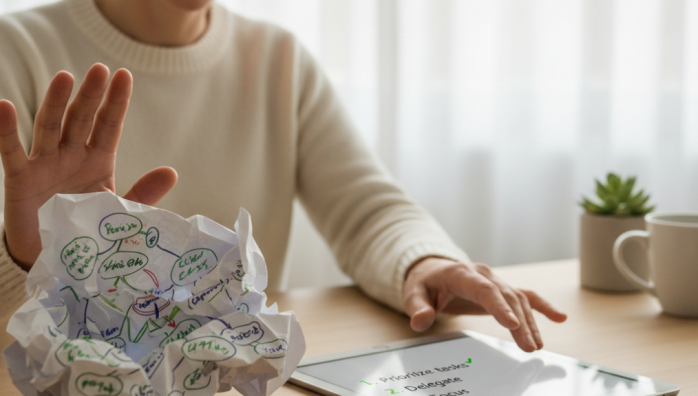
For years, I was a devout follower of the Getting Things Done (GTD) methodology. The promise of a \'mind like water\' was intoxicating. I read the book, set up my contexts, and dutifully performed my weekly reviews. In the beginning, it felt like I had discovered a superpower. Every task was captured, every project defined. I felt in control. But over time, a subtle anxiety began to creep in. The system that was supposed to liberate my mind started to feel like a cage.
The honeymoon phase with GTD
I remember the initial clarity. Dumping everything from my head into a trusted inbox was revolutionary. For the first time, I wasn\'t worried about forgetting a brilliant idea or an important follow-up. Processing that inbox into projects and next actions gave me a sense of order I\'d never experienced. My digital task manager was a pristine, perfectly organized machine, and I honestly felt more productive than ever.
Where the cracks started to show
The problem with pristine machines is that they require constant, meticulous maintenance. After about six months, the very structure that gave me freedom started to feel rigid and demanding. I found myself spending more time managing my productivity system than actually being productive. It was a classic case of the tool becoming the task.
The weekly review was my breaking point
Honestly, the weekly review became a source of dread. What was meant to be an hour of calm reflection and planning often turned into a two-hour administrative slog. I\'d postpone it, then feel guilty. When I did force myself to do it, I felt exhausted afterward. It was the moment I realized my system was serving itself, not me.
Contexts in a digital-first world
The concept of contexts like @office, @home, or @errands also started to feel archaic. I work from a laptop, and my \'@computer\' context contained 90% of my tasks. The lines are so blurred now. Was responding to a personal email from my work laptop a @home or @computer task? The friction of making these small decisions added up, creating resistance to even looking at my lists.
Building my \'good enough\' system
So, I quit. I declared GTD bankruptcy and started from scratch. But I didn\'t throw everything away. I kept the parts that truly served me and discarded the rest. I call it my hybrid, \'good enough\' system, and it’s based on simplicity and flexibility.
Here are the core principles I landed on:
- Keep the Inbox: The universal capture habit is GTD\'s single greatest gift. I still have one place where every idea, task, and note goes first. No exceptions.
- Simplify Processing: Instead of complex projects and contexts, I ask one question: \'When might I want to think about this again?\' The answer sorts tasks into three simple buckets: Today, This Week, or Later. That\'s it.
- Focus on \'Today\': Every morning, I look at my \'This Week\' list and pull 3-5 critical tasks into my \'Today\' list. This is my entire focus. The \'Later\' list only gets reviewed once a week, and it\'s a low-pressure scan.
- Embrace Imperfection: My system isn\'t always perfectly up-to-date, and that\'s okay. The goal is momentum, not perfection. If I miss a day of planning, I don\'t feel like I\'ve failed the system. I just pick it up the next day.
Ditching the dogma of a rigid system was liberating. I learned that the best productivity method isn\'t one you adopt, but one you adapt. It\'s a personal tool, not a universal law. And for me, \'good enough\' is finally good enough.