Why I Ditched Complex Productivity Systems for a Single Notebook
by admin in Productivity & Tools 174 - Last Update December 5, 2025
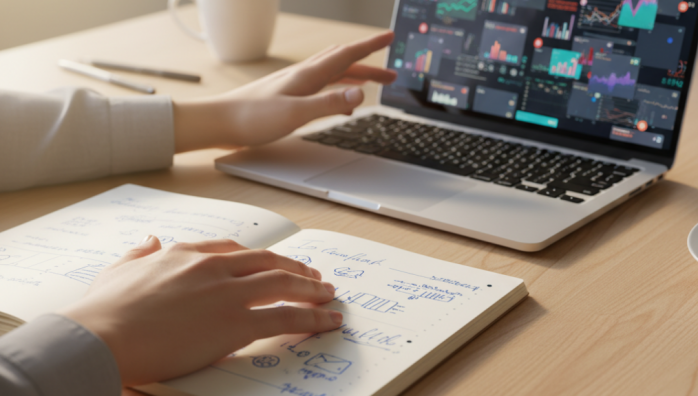
I used to be a productivity system junkie. If a new app promised to organize my life into a seamless, automated workflow, I was the first to sign up. I had task managers with nested sub-tasks, note-taking apps with bi-directional linking, and project management boards with more columns than a Greek temple. For a while, I felt like I was at the cutting edge of efficiency. The truth? I was just getting better at organizing my organizer.
My days started not with deep work, but with \'system maintenance\'—migrating tasks, re-tagging notes, and tweaking dashboards. I was so caught up in the architecture of my productivity that I was barely laying any bricks. It was a classic case of confusing motion with progress. The \'aha\' moment came when I missed a critical deadline, not because I forgot, but because the task was buried three levels deep in a project I hadn\'t synced correctly. I was being managed by my system, and I was exhausted.
The promise and the problem with digital complexity
The allure of these complex systems is powerful. They promise a world where nothing falls through the cracks, where every thought is captured and connected to a larger web of knowledge. And for some people, perhaps that works. But for me, it created a massive cognitive overhead. I spent more time thinking about *where* a piece of information should go than thinking about the information itself.
I realized I had built a beautiful, intricate digital prison for my ideas. The friction was immense. Capturing a fleeting thought required unlocking my phone, finding the right app, navigating to the right page, and applying the correct tags. By then, the initial spark of the idea was often gone, replaced by a dull administrative chore.
The radical analog experiment
In a moment of frustration, I decided to try something that felt almost regressive. I bought a simple, well-made notebook and a pen that felt good in my hand. That was it. No apps, no subscriptions, no tutorials. My entire \'system\' could now fit in my bag and didn\'t need a battery.
Honestly, the first few days were filled with a low-grade anxiety. What if I needed to search for something? What if I lost it? What about my beautiful web of interconnected notes? But I stuck with it, and what I discovered was surprising.
What i found in that first week
- Instant Capture: An idea strikes, I open the book and write. There is zero friction. The thought is on the page in seconds, pure and unfiltered.
- Improved Memory: The physical act of writing things down seared them into my memory in a way that typing never could. I found myself recalling my to-do list without even looking at it.
- Forced Prioritization: With a finite amount of page space, I had to be more intentional. I couldn\'t just add 100 tasks to a digital backlog. I had to choose what was truly important for the day.
- Intentional Disconnection: There are no notifications in a notebook. When I open it, I\'m there to work on my plans, not to be distracted by a pop-up or a new email. It became a space for focused thought.
My ridiculously simple \'system\'
People ask me what my notebook system is, and they\'re often disappointed by the answer. I don\'t have a fancy index or complex signifiers. Here\'s what I do:
- The Daily List: Each morning, I take a fresh page. I write the date at the top. I migrate any unfinished tasks from the day before and then list the 3-5 most important things I need to accomplish.
- Freeform Notes: The rest of the page is for anything that comes up during the day—meeting notes, ideas, phone numbers, doodles. It\'s a chronological log of my day.
- Weekly Review: On Friday afternoon, I spend 15 minutes flipping back through the week\'s pages. I cross off what\'s done, reflect on what wasn\'t, and get a clear picture of where my time actually went.
That\'s it. It’s not revolutionary, but it\'s real. I ditched the illusion of perfect organization for the tangible reality of getting meaningful work done. My digital tools still exist for collaboration and communication, but my thinking, my planning, and my focus now live on paper. And honestly, I\'ve never felt more productive.