Tracking Habits with Digital Tools
by admin in Productivity & Tools 115 - Last Update November 30, 2025
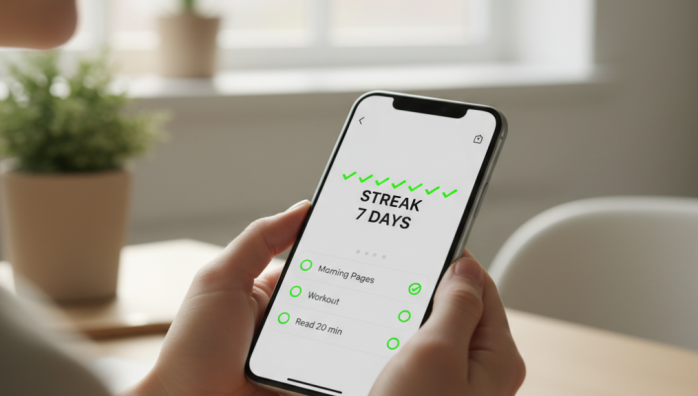
For years, my desk drawer was a graveyard of beautifully designed paper habit trackers. I’d start each month with incredible optimism, filling in the little boxes for a week, maybe two. Then I’d miss a day. The blank space would stare at me, a tiny monument to my failure, and the whole system would collapse. I honestly thought I was just bad at building habits. It wasn\'t until I reluctantly moved my tracking from paper to a screen that I realized the problem wasn\'t me; it was my toolkit.
Why digital tools changed the game for me
The first major shift was accessibility. My phone is always with me. There was no longer the excuse of “I’ll fill it in when I get home.” I could mark a habit as complete the second I finished it, which provided a small but powerful dopamine hit. But the real \'aha\' moment for me came from the data. Seeing a 10-day streak for \'morning walk\' visualized in a simple graph was more motivating than a row of checkmarks ever was. It gamified the process just enough to keep me engaged. Digital tools transformed tracking from a retrospective chore into a real-time, interactive process.
Choosing the right digital habit tracker
When I first started, I made the classic mistake of downloading the most complex, feature-rich app I could find. It had integrations, custom dashboards, and a million settings. It was overwhelming, and I abandoned it within a week. After that failure, I developed a simple checklist for choosing a tool. For me, it had to be three things: minimalist in design, available on both my phone and laptop, and capable of showing me simple progress charts. I learned that the best tool isn\'t the one with the most features; it\'s the one that adds the least amount of friction to your life. Anything that takes more than five seconds to update is a system destined to fail, at least in my experience.
My simple system for digital habit tracking
A great tool is useless without a solid system. Over the years, I\'ve refined my approach down to a few core principles that have worked wonders for me. It’s less about the tech and more about the psychology behind it.
Start with just one habit
I can\'t stress this enough. My early attempts were a disaster because I tried to track ten new habits at once. \'Read more,\' \'drink water,\' \'meditate,\' \'exercise\'—it was too much. Now, when I want to build a new habit, I focus on just one for at least 30 days. Once it feels automatic, I consider adding another. This slow, deliberate approach is the only thing that has ever led to lasting change for me.
Set up smart reminders, not annoying nags
Most apps allow you to set reminders. I used to set them as harsh, demanding alarms, which I quickly learned to ignore. Now, I use them as gentle, contextual cues. For my \'read before bed\' habit, the reminder pops up 30 minutes before I plan to sleep, phrased as a question: “Ready to wind down with a book?” It feels like a helpful suggestion from a personal assistant, not a command from a drill sergeant.
The weekly review is non-negotiable
Every Sunday, I spend about 15 minutes looking at my habit data from the past week. This isn\'t about judging myself for missed days. It\'s about curiosity. I ask myself: Why did I miss my workout on Wednesday? Oh, I had a late meeting. Maybe I should schedule my workouts for the morning. This review process turns my tracking data into actionable insights, allowing me to adjust my system for the week ahead instead of blindly repeating the same mistakes.
Ultimately, I\'ve come to believe that tracking habits with digital tools isn\'t about achieving a perfect, unbroken chain. It’s about building self-awareness. It\'s about having an honest, data-informed conversation with yourself each week, making small adjustments, and celebrating the progress you do make. The tool is just the facilitator of that conversation.