The PARA Method is a Lie: My Journey to a Simpler System
by admin in Productivity & Tools 117 - Last Update December 3, 2025
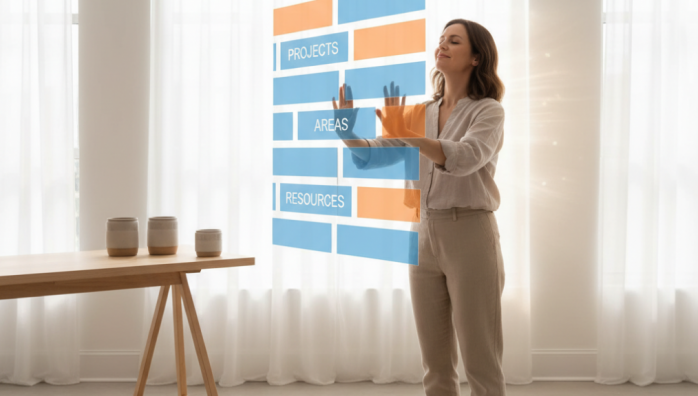
I\'m going to say something that might sound like productivity blasphemy: The PARA method is a lie. Not a malicious lie, but a seductive one. It promises a perfectly organized digital life, a \'second brain\' where every piece of information has its place. I bought into it completely. I spent weeks meticulously migrating my notes into Projects, Areas, Resources, and Archives. For a moment, it felt like magic. But then, the system started to fight back.
Where the promise fell apart for me
Honestly, the initial structure felt empowering. It seemed like the final answer to digital chaos. However, over the next few months, I noticed I was spending more time managing the system than actually using it. The friction started to build in subtle ways, and I almost didn\'t notice it until I felt completely stuck.
The friction of forced categorization
The biggest hurdle for me was the constant decision-making. Is this new idea a \'Project\' or is it related to an \'Area\'? Is this article a \'Resource\' for a specific project, or general knowledge? This micro-decision, repeated dozens of time a day, created a surprising amount of cognitive load. I found myself hesitating to save things because I didn\'t want to make the \'wrong\' choice. My system, designed for clarity, was causing paralysis.
The myth of the perfect archive
My \'Resources\' folder became a digital graveyard. It was a bottomless pit of articles, notes, and links that I promised myself I\'d \'get to later\'. The act of filing them felt productive, but in reality, I almost never went back. The effort of categorization didn\'t translate into value. The same went for the \'Archive\'. It was a tidy, well-organized digital space that I simply never visited. It was out of sight, and truly out of mind.
My \'aha\' moment: action over organization
The turning point came when I missed an important deadline. I realized I had the information I needed, but it was buried in a \'Project\' folder that I hadn\'t looked at because my focus had shifted. I had become a digital librarian, not a creator or a doer. My \'aha\' moment was this: My goal isn\'t to build a perfect library of my life; it\'s to make progress on what matters right now. I decided to tear it all down and start over, guided by one principle: Actionability.
What my simpler system looks like now
I abandoned the rigid PARA framework for something fluid and almost laughably simple. It\'s less of a system and more of a workflow. It has three core components:
- 1. Inbox: A single place where everything new lands. Notes, ideas, links, tasks. I process this once a day.
- 2. Active: This is my focus zone. It contains only folders and files related to the 3-5 things I am actively working on *this week*. It\'s small, manageable, and everything in it is relevant *now*.
- 3. Library: This is my new \'Resources\' and \'Archive\' combined. It\'s a flat folder structure. I don\'t categorize by topic. Instead, I rely entirely on powerful search and a few key tags. I trust my tools to find what I need, rather than my own fallible filing system.
That\'s it. When a project in \'Active\' is done, its contents move to the \'Library\'. The system is designed to keep my immediate workspace clean and my long-term storage searchable. The lie of PARA wasn\'t that it\'s a bad system, but that any single system is a universal truth. For me, simplicity and a ruthless focus on action won out over the dream of perfect organization.