Implementing Time Blocking for Deep Work
by admin in Productivity & Tools 238 - Last Update December 4, 2025
For years, my productivity system was a chaotic mess of sticky notes and an ever-expanding to-do list. I felt busy, constantly hopping from task to task, but at the end of the day, I had little to show for it. The needle wasn\'t moving on my most important projects. I was stuck in a cycle of what I now call \'shallow work\'. The turning point for me was discovering the concept of time blocking, not as a rigid set of rules, but as a framework for intentionally dedicating my focus. It wasn\'t an overnight fix, but it was the start of reclaiming my attention from the constant digital noise.
Why a simple to-do list wasn\'t enough
I used to believe that a comprehensive to-do list was the key to being productive. I\'d list out twenty things I needed to accomplish, and I\'d feel a sense of control. But in reality, it was an illusion. My brain would naturally gravitate towards the easiest, quickest tasks first, giving me cheap dopamine hits while the high-impact, cognitively demanding \'deep work\' got pushed to the back burner, day after day. A list tells you *what* you need to do, but it offers no strategy for *when* or *how* you\'ll do it. That was the missing piece for me.
The hidden cost of context switching
I realized my days were spent reacting. An email notification here, a quick question on a messaging app there. Each interruption, no matter how small, forced a context switch. It felt harmless, but the mental energy required to disengage, handle the new thing, and then re-engage with the original task was massive. I was bleeding focus without even knowing it. My to-do list didn\'t protect me from this; in fact, it often encouraged it by presenting a buffet of options to jump to whenever I hit a point of friction on a difficult task.
My personal approach to time blocking
After a lot of trial and error, I landed on a simple but effective process. It’s less about a specific app and more about a mindset shift. Here\'s how I structure my days to protect my time and energy for what truly matters.
Step 1: The weekly brain dump
Every Sunday evening, I spend about 20 minutes listing everything I need to accomplish in the coming week. Professional tasks, personal appointments, errands—it all goes onto a single list. Then, I ask the critical question: \'If I could only accomplish three of these things, which would have the biggest impact?\' Those become my priority deep work tasks for the week.
Step 2: Assigning time to tasks (and being realistic)
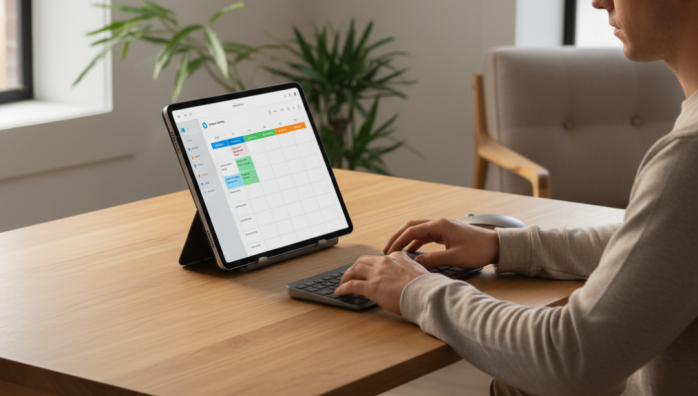
Next, I open my digital calendar and start creating blocks. A deep work block for \'Drafting the project proposal\' might get a two-hour slot on Tuesday morning. A block for \'Answering non-urgent emails\' gets 30 minutes in the afternoon. Honestly, I was terrible at estimating at first. I’d schedule a one-hour block for something that really needed two. But that\'s part of the learning process. Over time, you get a much better feel for how long things actually take.
Step 3: Creating buffer and reactive blocks
This was a game-changer for me. My initial mistake was creating a perfectly packed, back-to-back schedule. The moment one thing ran late or an urgent issue popped up, the entire day\'s plan would collapse. Now, I intentionally schedule \'buffer blocks\'—30-minute empty slots between major tasks. I also have a one-hour \'reactive work\' block in the late afternoon to handle all the unexpected things that inevitably come up. This transformed my schedule from a fragile house of cards into a resilient, flexible plan.
The biggest lesson i learned
The most important realization I had is that a time-blocked schedule is not a cage; it\'s a compass. It’s there to guide your intentions, not to dictate your every move with rigid, unforgiving precision. Some days, I get thrown off course, and that\'s okay. The goal isn\'t 100% adherence. The goal is to be more intentional with my time than I was yesterday. By deciding in advance what I\'m going to work on and when, I\'ve drastically reduced decision fatigue and created the mental space necessary for true, focused, deep work. It’s a continuous practice, not a one-time solution, and it has fundamentally changed my relationship with my work.