Building Sustainable Habits with Tracking Apps
by admin in Productivity & Tools 138 - Last Update November 21, 2025
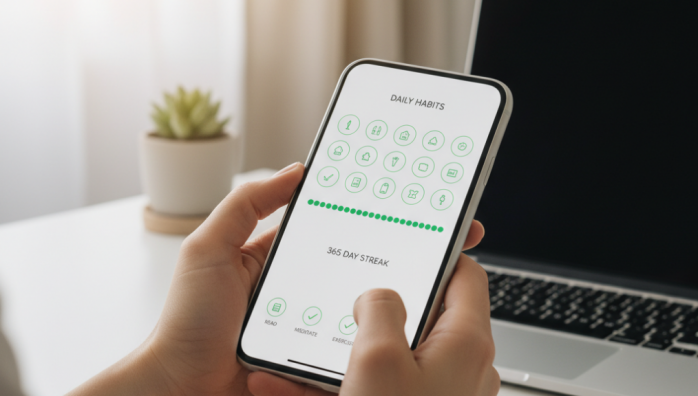
I used to be the champion of starting new habits and the undisputed king of quitting them by day three. The initial burst of motivation was exhilarating; I’d download a shiny new tracking app, fill it with a dozen ambitious goals like \'meditate 30 minutes daily\' and \'run 5k every morning,\' and feel like a new person. By the end of the week, the app was just a grid of red Xs, a digital monument to my own failure. It wasn\'t just discouraging; it was exhausting.
Why motivation isn\'t enough
For years, I believed my problem was a lack of discipline or willpower. I thought if I just tried harder, I\'d succeed. But here’s what I learned after countless failed attempts: motivation is a feeling, and feelings are fickle. It comes and goes. Relying on it to build a new life is like trying to build a house on shifting sand. A sustainable system, on the other hand, works even on the days you feel completely uninspired. The real foundation isn\'t raw effort; it\'s structure.
My first attempts with tracking apps (and my mistakes)
My early relationship with habit trackers was toxic. I saw them as a drill sergeant on my phone. Missing a day felt like a personal failing, and the app\'s notifications felt more like accusations than reminders. My biggest mistake was \'habit stacking\' in the worst way possible—trying to build an entire new identity overnight. Going from zero to ten new habits is a recipe for burnout. The app became another chore on my to-do list, and eventually, I’d delete it to escape the guilt.
The \'aha\' moment: data over discipline
The breakthrough came when I completely reframed the purpose of the app. It wasn\'t a judge; it was a lab notebook. Its job wasn\'t to tell me if I was \'good\' or \'bad,\' but simply to collect data on my own behavior. I stopped chasing the perfect, unbroken streak and started looking for patterns. This shift from discipline to data was everything.
I decided to try an experiment. I picked one, ridiculously simple habit: read one single page of a book each day. It was so easy that it felt silly not to do it. Tapping that \'complete\' button in my tracker gave me a tiny dopamine hit. Soon, I had a streak of 7 days, then 14, then 30. Seeing that visual proof of consistency was more motivating than the habit itself. The app was no longer a source of shame; it was a source of momentum.
How i choose and use a habit tracker today
After trying dozens of apps, I\'ve landed on a few core principles for choosing one that actually helps rather than hinders. For me, a good tracking app must have these qualities:
- Simplicity: It has to be fast. If logging my habit takes more than ten seconds, I know from experience that I\'ll eventually stop doing it. The less friction, the better.
- Flexibility: Life is messy. I need an app that lets me skip a day for travel or illness without branding me a failure and resetting my streak to zero. Positive reinforcement is key.
- Visual Clarity: I want to see my progress at a glance. A simple calendar view or a graph showing my consistency over time is incredibly powerful. It\'s a visual reminder that small efforts compound.
Ultimately, I realized the app is just a tool. It’s the mindset behind it that counts. It’s not about achieving a perfect record; it\'s about building a system for consistency, forgiving yourself for the occasional slip-up, and using objective data to understand yourself better. That\'s how I finally started building habits that last.