Building a Zettelkasten Digital System
by admin in Productivity & Tools 148 - Last Update December 6, 2025
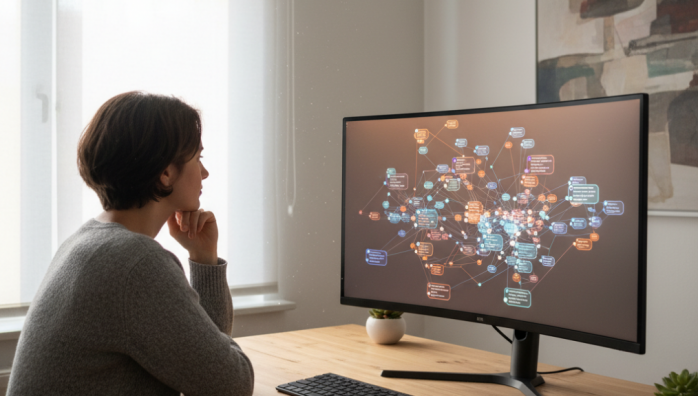
For years, my digital note-taking system was a black hole. I\'d clip articles, jot down meeting notes, and save profound quotes, all neatly filed away in a complex system of folders. The problem? I rarely ever looked at them again. It was a digital graveyard of good intentions. I had information, but I didn\'t have knowledge. The switch to a Zettelkasten-inspired system wasn\'t just a change in software; it was a fundamental shift in how I think about my ideas.
Why I finally abandoned folders and hierarchies
Honestly, the folder system felt productive. It gave me a sense of control and organization. But in practice, it was incredibly rigid. An idea could often belong in multiple folders, so I was constantly faced with a choice: Do I file this under \'Productivity\' or \'Project Management\'? Do I duplicate the note? This friction was enough to stop me from engaging with my own thoughts. I realized that my brain doesn\'t think in neat, hierarchical folders—it thinks in networks and associations. The system I was using was fighting the natural way I process information, and it was a losing battle.
The core principles I learned the hard way
Getting started with Zettelkasten was surprisingly difficult because it required unlearning years of bad habits. It\'s less about the tool you use and more about the principles you follow. After a few false starts, I landed on three non-negotiable rules that made all the difference for me.
Atomic notes: one idea, one note
My biggest initial mistake was creating massive notes filled with dozens of bullet points from a book or lecture. These \'content blob\' notes were impossible to link to in a meaningful way. The breakthrough came when I forced myself to adhere to the principle of atomicity. Every single note file in my system now contains one single, distinct idea, written in my own words. This makes each note a modular building block that can be linked and re-linked in countless contexts, forming new insights I\'d never have seen otherwise.
Linking is the real magic
This is where the system truly comes alive. Instead of just filing a note away, the last step is always asking, \'How does this connect to what I already know?\' I then create explicit links to other related atomic notes. Over time, this practice builds a web of interconnected thought. It\'s an incredible feeling to be working on a new idea and, through your links, rediscover a related thought you had months or even years ago. It’s a conversation with your past self that sparks new creative directions.
The power of rephrasing
I never, ever just copy and paste. The rule is that every idea must be processed and rephrased in my own language. This simple act forces me to actually understand the concept rather than just passively collecting it. It’s the difference between being a librarian of information and being an author of knowledge. This step slows you down, but it\'s where the deep learning and retention actually happen.
My simple digital setup
I\'ve tried a few different tools, and what I\'ve learned is that the specific app matters far less than its core functionality. The only critical features you need are the ability to create new notes quickly and, most importantly, the ability to create bidirectional links between them. You want to be able to see not just the notes you\'ve linked *to*, but also the notes that link *back* to the one you\'re viewing. This is what allows for serendipitous discovery and seeing the context of an idea. Whether it\'s a simple text-based system or a more visual one, as long as it supports this core linking function, it can work.
A final reflection on the process
Building a digital Zettelkasten is not a one-time project; it’s an ongoing practice. It\'s a garden of ideas that you have to tend to regularly. Some days I add a dozen new notes, other days only one. But every single addition and every new link strengthens the entire network. It has transformed my notes from a passive archive into an active partner in my thinking and creative process. I no longer lose ideas; I connect them.